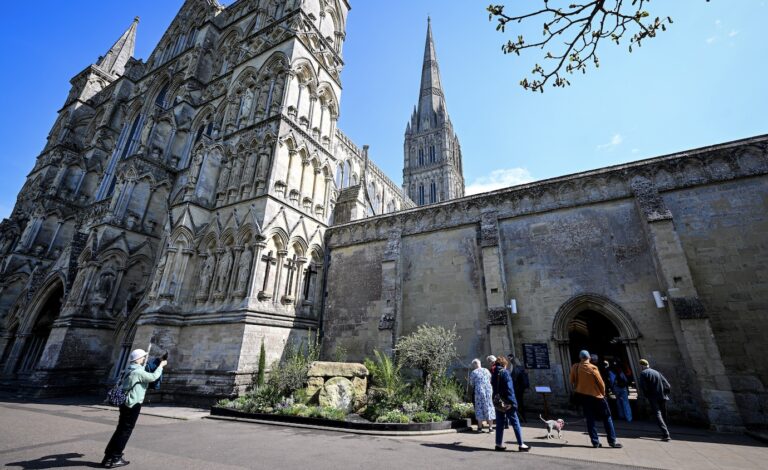
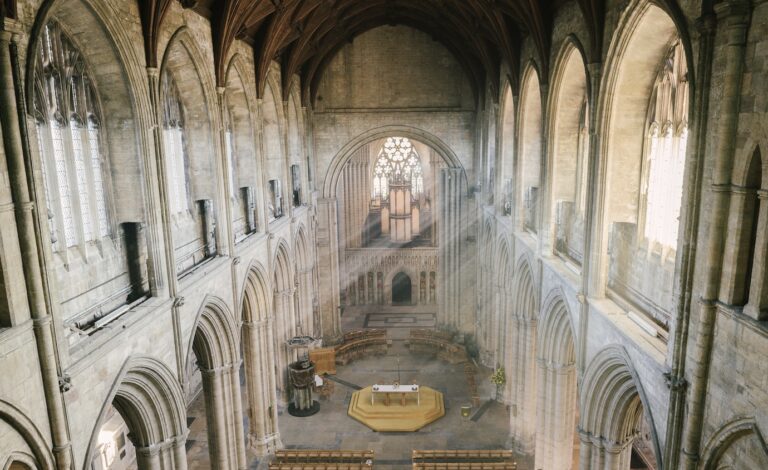
The Nation’s favourite stained glass window – have your say and be in with a chance of winning Divine Light by Janet Gough OBE.
Voting is now closed. We’re counting the votes and the top 5 will be revealed starting tomorrow, 2nd February.
Find out more about the windows below.

Carlisle Cathedral – East Window (1359)

Flowing Decorated tracery with stained glass of the Last Judgement from 1350s, attributed to Ivo de Raughton, lower panes on the life of Jesus by Hardman & Co. of Birmingham (1861), 17.6 × 8 m
Chester Cathedral – Cloister Windows (1920s)
Thirty-four windows with 130 lights, presented as an Anglican calendar, most from the studio of F.C. Eden (1864–1944) and A.K. Nicholson (1871–1937), alongside designs by Chester artist Trena Cox (1895–1980), cloister window 2.4 × 0.4 m
Ely Cathedral – Processional Way Windows (2000)
Fourteen geometric grisaille lights, 1.8 x 1.6 m, designed by Helen Whittaker (b. 1974) and made by Barley Studio, for the 2000 Processional Way by Jane Kennedy (b. 1953), linking the Lady Chapel to the Cathedral, three blocks of four lights and two lancets.
Gloucester Cathedral – Great East Window (c.1360)
Floor-to-ceiling tiered and canted window depicting the Church’s earthly authorities, saints, Apostles, Mary and Christ, and the heavenly realm of angels, 22 × 14 m (roughly the size of a tennis court)
Newcastle Cathedral – Chemist’s Window (1866)
Memorial to chemist Joseph Garnet (d. 1861), designed by William Wailes (1808–81), south quire aisle, 4.3 × 3 m
Sheffield Cathedral – Te Deum Window (1948)
Designed by Christopher Webb (1886–1966), Chapel of the Holy Spirit, window 7 × 4 m
St Albans Cathedral – Rose Window (1989)
Sixty-four openings of 18,000 pieces of hand-blown ‘antique glass’ as creation and the created universe, Alan Younger (1933–2004), north transept, diameter 9.1 m
St George’s Chapel, Windsor Castle – West Window (1509)
Seventy-five lights containing stained-glass painted figures, of which sixty-five survive from before 1509, including several by Flemish glazier (and King’s glazier from 1505) Barnard Flower (d.1517), 11 × 9 m
Wells Cathedral – Jesse Window (c.1340)
Seven lights with twenty-seven panels in lustrous symmetrical Curvilinear scheme, high gable at east end of quire, c.7.5 × 6.5 m
Westminster Abbey – Great West Window (1735)
Thought to have been designed by James Thornhill (1675–1734), made by William Price (d. 1765), 13.7 × 9.4 m
Worcester Cathedral – Creation & Fall West Window (1875)
Eight vertical lights (each 8.6 × 0.7 m) with brightly coloured glass in medallions; tracery and rose window (diameter 4.2 m) above; designed by John Hardman Powell and made by Hardman & Co. of Birmingham
York Minster – Great East Window (1405–8)
117 narrative panels in rows of nine from the Creation to the Apocalypse, with over 300 panels in total, by John Thornton of Coventry (active 1405–33), 23.2 × 9.8 m
Don’t forget to vote for your favourite and you could win a copy of Janet Goughs, Divine Light – the Stained Glass of England’s Cathedrals.