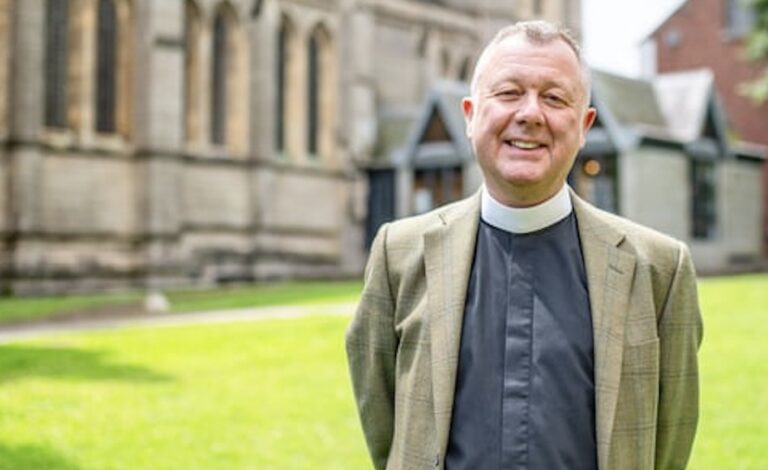
It’s been a labour of love for the Dean of Rochester – a project started in lockdown to celebrate and honour a predecessor has become a crucial wellbeing and mental health support for the communities the cathedral serves.

Now the Dean, the Very Revd Philip Hesketh, is waiting to hear if the Cathedral will receive funding to employ a horticultural therapist – the next phase of the cathedral’s wellbeing programme combining music, the arts and gardening – a direct nod to his predecessor’s belief that the garden could have a direct impact on people’s health and wellbeing.
The Very Revd Philip Hesketh began to restore and develop the secret gardens at Rochester Cathedral in celebration of its former Dean, Samuel Reynolds Hole who was a celebrated horticulturalist in Victorian Britain and founding president of the UK Rose Society.
Dean Samuel Hole was Dean of Rochester from 1877 until his death in 1904. During that time, he laid out a garden and planted a rose collection that numbered 135 varieties.
Pioneering garden designer and artist, Gerturde Jeykll was a regular visitor and was so impressed by the gardens that she included them in her book – Classic English Gardens with paintings by George S Elgood – the original watercolour of which is now amongst the current Dean’s collection of Dean Hole’s artifacts after he tracked it down to America.
“He who would have beautiful Roses in his garden must have beautiful Roses in his heart”.
So wrote Dean Hole in his volume, A Book About Roses. Rose enthusiasts argue it did more to popularise the rose in English gardens than, perhaps, any other publication.
Written in 1869 and running into multiple editions and languages, this small book about Queen Rosa earned Dean Hole the title the ‘Rose King’ from the poet laureate, Alfred, Lord Tennyson.
“He was known as the ‘king of the roses’ and after I learned he had a remarkable garden at the Deanery in Rochester, I wanted to restore it and reinstate his rose garden as well as the older varieties of flowers he introduced to the gardens,” said Dean Philip.
And so it began. The labour of love. The restoration and development of three acres of secret gardens hidden behind the cathedral, reinstating some of Dean Hole’s favourite roses ( including his celebrated Gloire de Dijon), creating a wildflower meadow, a fruit orchard, installing beehives, recreating ponds, and planting a small vineyard and an infirmary herb garden, mirroring the agricultural history of the cathedral’s monks that would have used the Deanery garden.
“I absolutely love gardening. I enjoy the peace, serenity and satisfaction of watching things grow and flourish,” Philip said.
“It also helps us connect with history while enhancing the biodiversity and beauty of the Cathedral grounds and opening up the space to community groups.
‘I wanted to use the gardens for projects for mental health, well-being, prayer and spiritual growth and the long-term goal for this space was to open it up to offer that to more community groups, ’ he said.
Like the local Veterans group who have reinstated a summer house and decorated it with their own stained glass artwork, there’s a dementia groupand a local care home who use the space, mixing singing with simply being out in nature.
There are three cherry blossom trees from Japan too, part of a project to link the two countries and there will be opportunities for a community growing space in the future.
And at the centre of this project is a museum dedicated to Dean Hole with artifacts collected over the years by Philip – and a life-sized plaster figure of Dean Hole just waiting to be cast!
The Dean is waiting to hear if the Cathedral will receive funding to employ a horticultural therapist.
‘This is the next phase. The gardens and orchard will become a central part of the Cathedral’s wellbeing programme which will combine music, the arts and gardening.
‘I feel I have prepared the ground for this exciting and essential project to go forward, which will help build communities of hope.’
The Secret Gardens at Rochester Cathedral will be open to the public on the 18th April and the 6th of June this year.
You can read Dean Philip’s blog on Dean Reynolds and his roses here.