Art in Cathedrals
These are some of the art exhibitions available for cathedrals to host.
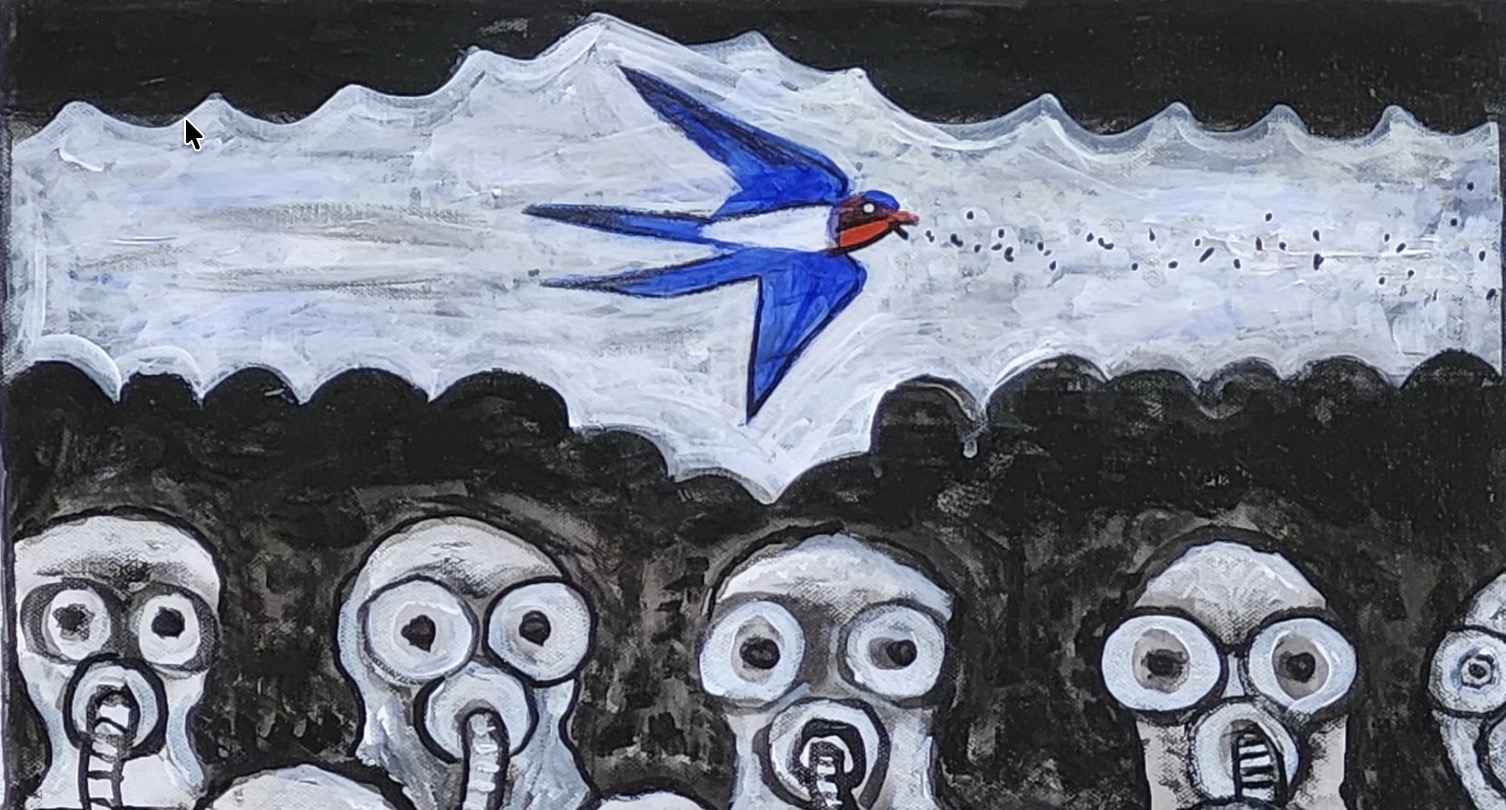
Noah : A Future Hope
In review, NOAH: A Future Hope began touring late last year, premiering in Houston. The exhibition is an artistic exploration featuring three premier contemporary artists from the faith traditions of Judaism, Christianity and Islam, of the importance of caretaking the earth (i.e. environmental sustainability, climate change and climate catastrophe) inspired by the story of Noah, the ancient flood narrative found in all the Abrahamic faiths. It will tour for three years, first in North America, then a couple venues in Europe, and hopefully end up in the Middle East. In this regard, we would love to see the exhibition come to a key sacred space in the UK sometime in 2028.
For NOAH: A Future Hope, the ancient narrative of Noah, the most well-known epic flood story, serves as an artistic platform for engaging discussion, inspiring action and effecting change regarding our responsibility as agents in the preservation of life on earth and our environment. The exhibition features celebrated contemporary artists: Yona Verwer (Dutch Jewish), Brian Whelan (Irish Christian) and Hady Boraey (Egyptian Muslim). Hence, it is also a catalyst for interfaith cooperation. The objective of NOAH: A Future Hope is to be a creative catalyst that inspires a brighter path to a promising future, offering a message of hope for future generations.
It will tour for over three years to art venues, cultural centres, university art spaces, and heavily-trafficked sacred spaces. The exhibition serves as a catalyst for each host venue to develop a variety of events and programs (associated programming) tailored to the specific needs of their communities to stimulate discussion, dialogue and education around the exhibition’s theme toward promoting further understanding.
Attached is the latest Overview on NOAH: A Future Hope which will give you a fuller picture of what it is all about. Also, here are some links that provide further information.
- Article in The Culturium: https://www.theculturium.com/noah-a-future-hope
- Online Catalogue: https://heyzine.com/flip-book/07358f7de5.html
- Website exhibition page: www.oncaravan.org/noah
- A short video showing the display of the exhibition while in Houston: https://www.youtube.com/watch?v=eq-_hOwA-IE
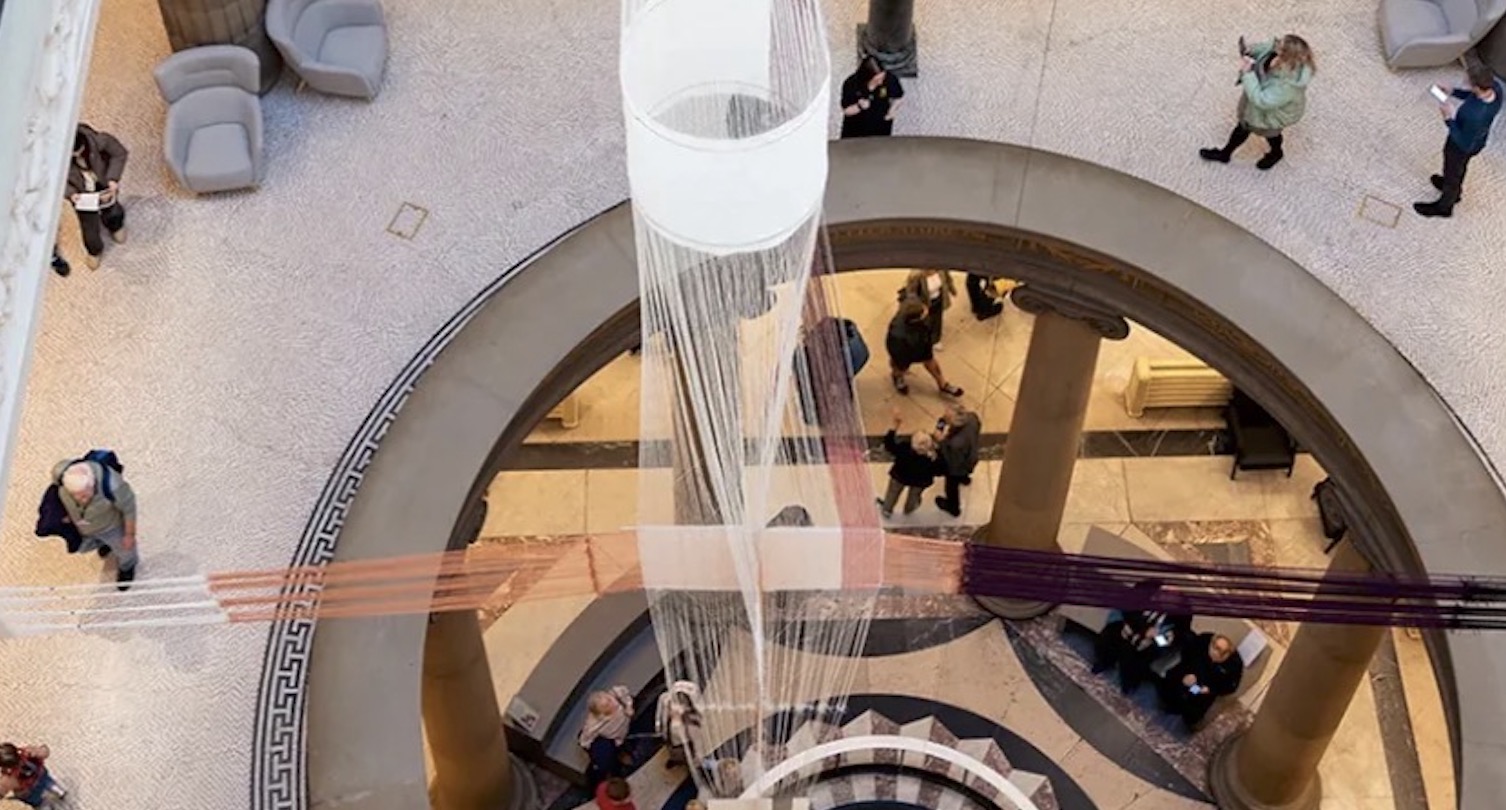
Transformation | Hannah Robson and Jacqueline Moore
Transformation is a new sculpture commissioned by The Harris and the British Textile Biennial. The work responds to research into Rayon making and the Courtaulds factory in Preston, drawing from the material held at the museum.
The need to make textiles is fundamental and it has shaped our social structures and the physical arrangements of our towns and cities. Yarn is the first building block in the making of cloth.
Rayon was the first commercially viable artificial fibre. The idea of creating a new fibre through human innovation was dreamt of long before Rayon was eventually developed. As far back as 1665, Robert Hooke considered this possibility while studying the structures of silk under his microscope. The long-shared dream of creating an artificial fibre emphasises the importance of thread for human life. It also speaks of a human curiosity to speculate, solve problems, explore and innovate. Rayon is made from cellulose (usually wood pulp or other plant matter) which is transformed into thread via chemical processing. It was an early man-made fibre and represents significant innovation. The first commercially viable version of Rayon was created by Courtaulds in 1905, Red Scar Works, a Courtaulds factory in Preston, was a major production site until it closed in 1979. Rayon has been used extensively in fashion for its soft, draping qualities; it has also been used in technical applications: such as parachutes, tensile ropes and car tyres. In the factory, wood pulp is transformed through steeping, shredding, ageing, xanthation, ripening and extruding – each stage changing its material properties through chemical reactions. As the mixture travels through the factory it shifts between solid and liquid states. The moment when it chemically becomes rayon, it is a bright orange liquid, before being extruded into yarn. The final stage of the process is to wash the yarn with bleach. Hannah has sought to capture the idea of material transformation and celebrate the magic of yarn. She has created a 18m textile sculpture. Most the piece is made from paper yarns – another material made from cellulose. The sculpture has been made through hand-weaving and knotting threads.
Seven precise three-dimensional woven shapes are connected by continuous threads which shift and twist in space, reorganising into different formations for each three-dimensional element. Coloured rayon yarns are interconnected with the paper, some have been bleached to change the colours throughthe piece. Hannah has used colours which reference the materials of the factory – the off white of the wood pulp, the black of coal, the orange of liquid rayon – along with some bright surprise colours created through the bleaching process. Knotting has also been used to construct the form. Tying a knot is an action synonymous with yarn. It is a commonplace action of the hands, but it also has an industrial counterpoint.
The knots in this sculpture have been tied with an industrial knotting machine – usually used in weaving factories to prepare warps for production. They are perfectly precise and consistent. Hannah is interested in the relationships between handmaking and industrial production – the connections between hands and machines.
More here.
Grounded – Touring Proposal
A partnership between Helen Barff (artist), Lucy Newman Cleeve (curator and priest), Close Ltd (gallery), YMCA LandAid House and Refugees at Home.
Overview
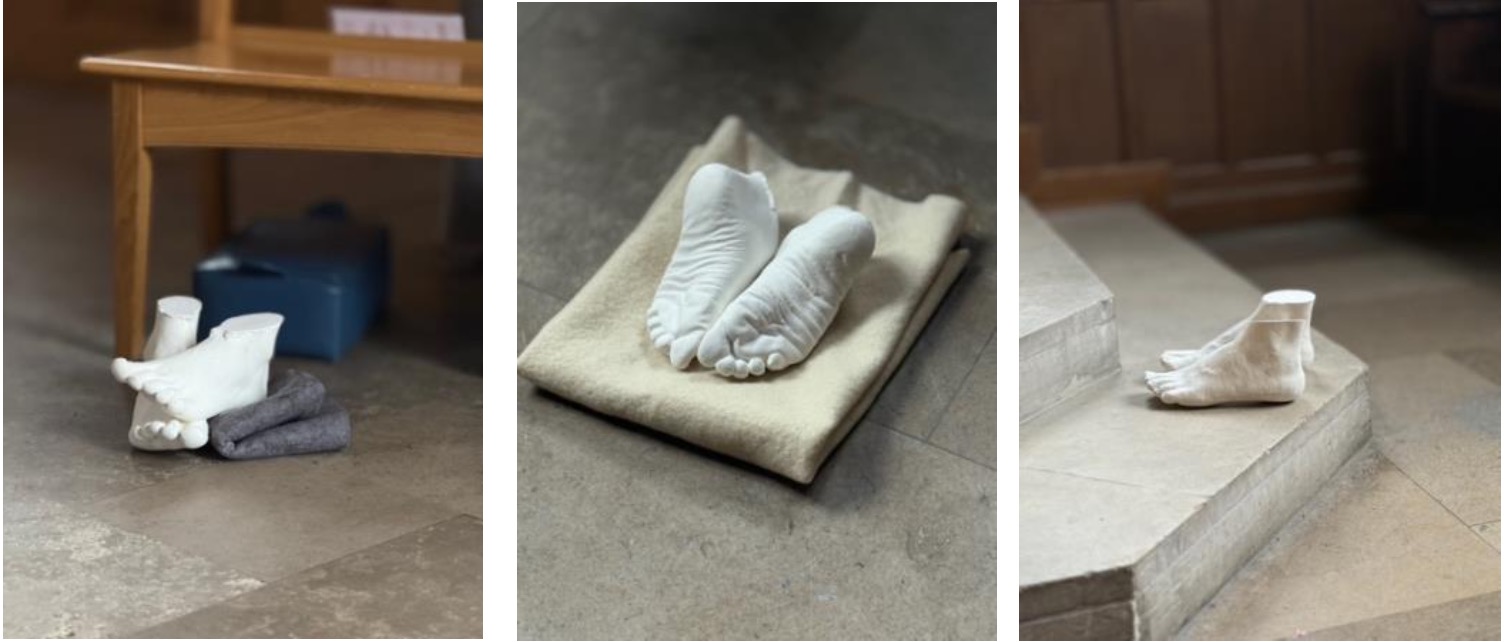
Grounded (previously The Ground That Gathers Beneath My Feet) was first shown at St Giles’ Cripplegate in autumn 2025. Plaster casts of bare feet were placed throughout the church – resting on stone, laid upon blankets, tucked beneath pews, set before the altar – as if their owners might return at any moment.
They were made by young residents from YMCA LandAid House who have experienced homelessness and displacement, during workshops led by artist Helen Barff, accompanied by Lucy Newman Cleeve in her role as chaplain.
Each cast bore the marks of lived experience: pressure points, scars, the wear of journeys taken.
Recorded interviews gave voice to stories of crossing borders and seas, of families scattered by war, of faith and endurance carried into new places. The installation invited visitors to pause and attend – to the objects, to the voices, and to their own relation to place and to others whose journeys intersect with their own.
Purpose and Approach
Questions of migration, belonging, and national identity continue to shape public life in Britain in complex and often charged ways. Grounded does not seek to resolve these tensions or to argue a position. It offers something more modest: a space in which difficult questions about home, fear, welcome, and responsibility can be held without being prematurely closed.
The work begins with the act of casting. The artist kneels before the participant, a change in posture that alters the dynamic of the exchange. It slows the moment and shifts the balance of attention. What follows may be conversation, or quiet, but nothing is required beyond being present together while the plaster sets.
As the project moves to new places, further casts and recordings will be made in dialogue with each host context. What emerges will not be identical in every location. Some casts may remain where they are made, be returned to participants, or be held locally. The work unfolds through relationship rather than replication.
Find out more here.
Other installations available for tour:
- Halima Cassell, Virtues of Unity – www.virtuesofunity.com/home
- Ben Edge – Two works are available from this work Children of Albion www.benedge.co.uk/latest-paintings-2021-2022
- Renaud Muraire –Sacred Resonance www.renaudmuraire.com – currently at Canterbury Cathedral
- Touching the Void – needs external funding – voiles by Alexander de Cadenet.
- Liz West – Colourwork installations – www.liz-west.com/installation